


 EN
EN



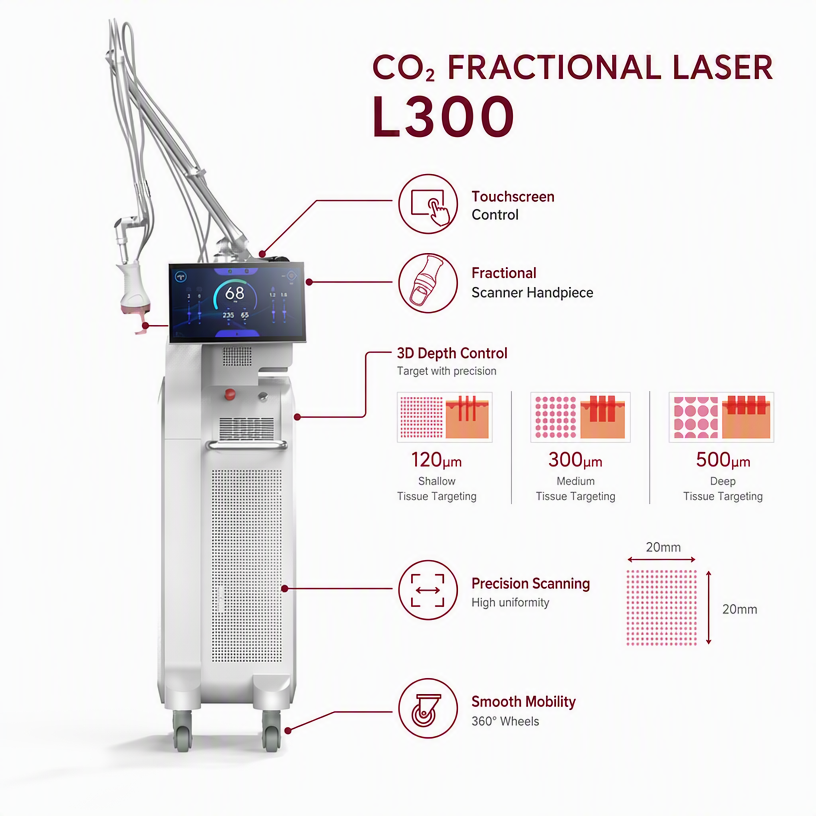
The delicate skin around the eyes represents one of the most challenging treatment areas in aesthetic and medical dermatology. This region demands exceptional precision, minimal thermal damage, and predictable outcomes that fractional CO2 laser technology uniquely delivers. A fractional CO2 laser works by creating microscopic columns of thermal injury in the skin while leaving surrounding tissue intact, allowing faster healing and reduced downtime compared to traditional ablative lasers. For eye area resurfacing specifically, the fractional CO2 laser has become the gold standard because it addresses fine lines, pigmentation irregularities, and textural concerns with unmatched control and safety.

Understanding how a fractional CO2 laser achieves precision in the eye area requires knowledge of both the technology and the biological response it generates. The fractional CO2 laser emits infrared light at 10,600 nanometers, which is strongly absorbed by water in skin tissue, creating instantaneous vaporization of targeted microareas. Medical professionals choose fractional CO2 laser systems for periocular applications because the beam can be precisely calibrated to treat only the epidermis and superficial dermis without penetrating too deeply, protecting underlying structures including the orbital rim and delicate eyelid tissue. This level of control makes fractional CO2 laser the preferred choice for institutions and clinics focused on safety-first eye area rejuvenation.
Mechanism and Precision of Fractional CO2 Laser Technology
How Fractional CO2 Laser Creates Controlled Ablation
A fractional CO2 laser operates through a scanning system that divides the treatment area into a grid pattern, delivering thousands of tiny laser pulses rather than one continuous beam. Each pulse from the fractional CO2 laser creates a zone of controlled thermal injury typically measuring 100 to 300 micrometers in diameter. Between these treated columns lies untreated skin that acts as a biological reservoir, accelerating wound healing and epithelialization. The fractional CO2 laser's adjustable settings allow clinicians to modify pulse duration, spacing, and energy density to match the specific requirements of eye area skin, which is thinner and more sensitive than surrounding facial areas.
Precision Parameters in Eye Area Applications
Eye area resurfacing using a fractional CO2 laser demands strict adherence to power and coverage settings that differ from treatments on thicker facial skin. The fractional CO2 laser's precision in the periocular zone typically operates at lower fluences—ranging from 40 to 70 millijoules per square centimeter—to minimize thermal diffusion beyond the target zone. Medical providers using a fractional CO2 laser near the eyes employ specialized eye protection systems, including metallic shields and protective eyewear, to prevent accidental exposure to the laser beam. The fractional CO2 laser's ability to deliver energy in fractionated micro-pulses rather than bulk ablation ensures that each treatment pass removes only the necessary amount of tissue while maintaining structural integrity in this cosmetically and functionally critical area.
Clinical Benefits and Safety Considerations
Aesthetic and Functional Outcomes
Patients treated with a fractional CO2 laser for eye area concerns experience visible improvement in fine lines, crow's feet, and periorbital wrinkles within two to three weeks as new collagen remodels. The fractional CO2 laser's mechanism stimulates neocollagenesis—new collagen formation—that continues for three to six months post-treatment, creating sustained tightening and improvement in skin quality. Beyond wrinkle reduction, a fractional CO2 laser effectively treats age spots, melasma, and uneven pigmentation in the eye area, which are common complaints in this cosmetically sensitive zone. The fractional CO2 laser also improves texture and laxity, addressing loose skin that often accompanies aging around the eyes and contributing to a more youthful, refreshed appearance.
Safety Profile and Healing Dynamics
The fractional CO2 laser offers a superior safety profile compared to traditional full-field ablative CO2 systems because the fractionated approach leaves intact skin between treatment zones. This fractional CO2 laser methodology reduces infection risk, minimizes hypertrophic scarring, and shortens the complete healing timeline to approximately one to two weeks rather than three to four weeks. Erythema and edema following a fractional CO2 laser treatment in the eye area typically resolve within seven to ten days, allowing patients to return to social activities sooner than with non-fractional approaches. The fractional CO2 laser's reduced thermal damage to surrounding tissue also decreases the incidence of post-inflammatory hyperpigmentation, a critical consideration for patients with darker skin types.
Treatment Protocol and Customization for Eye Area Resurfacing
Pre-Treatment Assessment and Planning
Successful eye area resurfacing with a fractional CO2 laser begins with thorough assessment of skin type, sun damage severity, patient expectations, and any history of herpes simplex virus or other contraindications. Clinicians evaluating candidates for a fractional CO2 laser treatment in the periocular zone must examine skin elasticity, degree of laxity, and specific concerns—whether primarily wrinkles, pigmentation, or textural irregularities. The fractional CO2 laser treatment protocol is then customized by adjusting parameters including coverage percentage, pulse duration, and number of passes to address the specific pathology. Pre-treatment preparation typically includes retinoid discontinuation for one week, sunscreen use, and antiviral prophylaxis for patients with history of herpes simplex to minimize reactivation risk during fractional CO2 laser healing.
Multi-Pass Technique and Real-Time Adjustment
The fractional CO2 laser allows clinicians to perform multiple passes over the same treatment area, with each pass penetrating slightly deeper into the dermis. A typical eye area resurfacing session using a fractional CO2 laser involves two to three passes, with the clinician observing skin response between passes and adjusting settings accordingly. The fractional CO2 laser's real-time feedback through visible tissue response—characterized by progressive erythema and slight swelling—guides clinicians in determining optimal treatment intensity without over-treating. After completing the fractional CO2 laser treatment, immediate post-treatment care includes cooling, hydration, and application of soothing occlusive dressings to support the fractional CO2 laser's wound healing response.
FAQ
What is the typical recovery time after a fractional CO2 laser eye area treatment?
Most patients experience significant healing within seven to ten days following a fractional CO2 laser treatment, with residual redness fading over two to four weeks. The fractional CO2 laser's fractionated approach promotes faster epithelialization compared to traditional ablative methods, allowing return to work and normal activities within one to two weeks. Full collagen remodeling and optimal results from a fractional CO2 laser continue developing over three to six months, with patients noticing progressive improvement in skin texture and fine lines throughout this period.
Can a fractional CO2 laser be used safely on all skin types for eye area resurfacing?
The fractional CO2 laser can be safely adapted for all skin types when treatment parameters are properly customized, though darker skin types require lower fluences and reduced coverage to minimize post-inflammatory hyperpigmentation risk. Clinicians using a fractional CO2 laser on patients with Fitzpatrick skin types IV through VI should employ conservative settings, fewer passes initially, and longer intervals between treatments. A fractional CO2 laser's precision allows practitioners to demonstrate excellent results across all skin tones when combined with appropriate pre- and post-treatment protocols, including strict sun protection and sometimes skin brightening adjuncts.
How many fractional CO2 laser treatments are needed for optimal eye area improvement?
Most patients achieve significant eye area rejuvenation with a single fractional CO2 laser treatment session, though some may benefit from a second treatment four to six weeks later for additional improvement. The fractional CO2 laser's collagen-stimulating effects continue progressing for months after the initial session, so waiting time allows assessment of results before committing to repeat treatments. For advanced photoaging or significant laxity, a series of two to three fractional CO2 laser treatments spaced six to eight weeks apart provides cumulative benefits without excessive downtime or risk, making this an effective long-term strategy for sustained eye area rejuvenation.