


 EN
EN



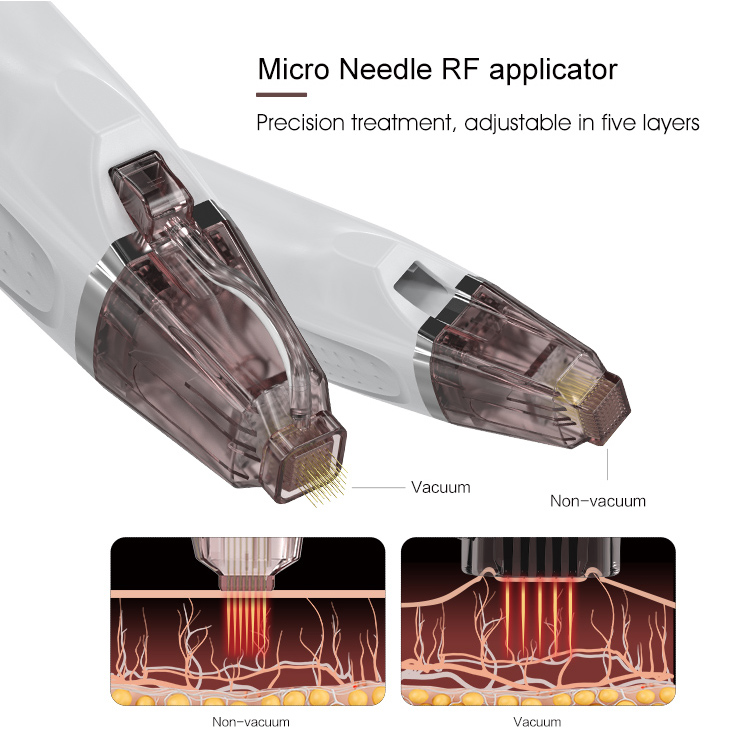
In the current aesthetic device market, many microneedling RF systems claim to include vacuum technology and insulated needles.
However, the real question is not simply whether these features exist, but how precisely they function during clinical treatment.
When evaluating a microneedling RF system, the key factor is not the presence of features, but how effectively the system delivers energy beneath the skin.
True clinical performance depends on treatment stability, energy precision, and system-level design.
1. Vacuum System: Precision Matters More Than Suction
Many microneedling devices use vacuum simply to pull the skin upward before needle insertion.
In these systems, the vacuum mainly acts as a basic skin fixation mechanism.
However, in real clinical treatment, the important questions are very different:
-
Does the needle enter the skin vertically and consistently after suction is applied?
-
Is the vacuum level stable across different facial areas?
-
When skin thickness changes, can the system avoid over-suction or insufficient suction?
These factors directly influence treatment consistency and safety.
Our Approach to Vacuum System Design
Our vacuum system is designed not merely to provide suction, but to ensure treatment stability.
Human skin naturally has uneven tension, particularly in areas such as the face, jawline, and neck.
Without a stability-driven vacuum system, these variations may lead to:
-
inconsistent needle penetration depth
-
uneven RF energy delivery
Our system is engineered to ensure that:
-
Each needle penetrates at a consistent depth
-
Each RF pulse reaches the intended treatment layer
In other words, vacuum is not used simply to lift the skin —
it is used to guarantee precision during every treatment shot.
2. Insulated Needles: It’s About Where Energy Is Delivered
Insulated needles are widely used in modern RF microneedling devices.
However, the critical factor is not just whether the needle is insulated, but how precisely the insulation is designed.
Many systems use insulation primarily to reduce overheating on the skin surface.
While this helps protect the epidermis, it does not necessarily ensure that RF energy is distributed correctly within the dermis.
Our Insulated Needle Design
Our insulated needles are engineered to confine RF energy within the effective dermal treatment zone, where collagen remodeling occurs.
This design helps achieve:
-
more precise thermal stimulation
-
improved treatment efficiency
-
enhanced safety for the epidermis
By controlling where energy is released, the system ensures that the therapeutic effect occurs exactly where it is needed.
3. A System-Level Clinical Design Philosophy
Microneedle RF technology should not be viewed as a collection of individual features.
Vacuum systems, needles, and parameters are simply tools within a larger treatment system.
What ultimately determines clinical outcomes is:
The energy distribution curve beneath the skin.
For this reason, our development approach focuses on clinical results first.
Instead of stacking features, we design the system by working backward from real treatment needs, optimizing:
-
vacuum stability
-
needle insulation structure
-
RF energy delivery logic
-
treatment parameter control
4. What Truly Differentiates Modern Microneedling Systems
Today, many manufacturers offer microneedling devices with similar feature lists.
However, the real differences lie in three critical factors:
-
Whether the vacuum system provides stable and controllable suction
-
Whether the needle insulation design ensures precise energy delivery
-
Whether the RF energy is released only within the effective dermal layer
These factors determine whether a system can deliver consistent, predictable clinical outcomes.
Our system is designed based on clinical performance and treatment precision, rather than simply focusing on parameter specifications.
Looking for a professional RF microneedling system?
Contact us to learn more about our advanced aesthetic devices designed for clinical precision and safety.